Browser GPU benchmark report
What 32,604 GPU Benchmarks Reveal About the Web in 2026
This browser GPU benchmark report analyzes 32,604 real submissions, covering WebGPU adoption, mobile dominance, performance tiers, and data quality signals.
Report frame
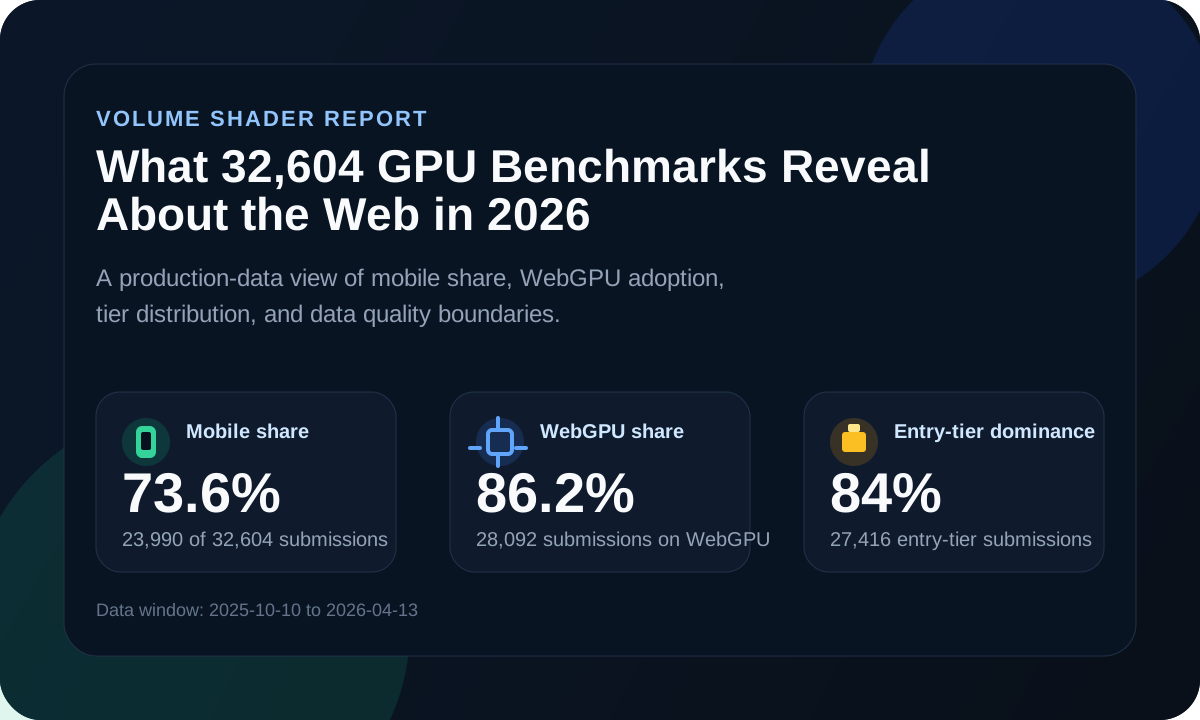
73.6%
of all submissions came from mobile devices
86.2%
of all runs used WebGPU rather than WebGL2
84%
of the dataset came from entry-tier GPUs
10,750
submissions were recorded in March 2026 alone
28,713
runs were marked preset-relevant by the fairness layer
Key takeaway
This is not mainly a story about halo GPUs. It is a story about whether browser graphics holds up on mainstream hardware, under real-world thermal, browser, and preset constraints.
Overview
Read this like a market report, not a lab shootout
The dataset is observational. That makes it messier than a controlled benchmark, but much closer to how browser graphics is actually experienced by real users.
What this report is good at
Spotting market structure, product priorities, and confidence limits.
The trend lines matter more than any single brag number because browser mix, fallback behavior, thermals, and session conditions all leak into production data.
Safe claim: the web graphics audience is mobile-heavy, entry-tier-heavy, and WebGPU-first.
Method
A production submission report with clear confidence boundaries
We queried the production Prisma-backed samples table and framed the results to show what the benchmark is strong at, and where the claims must stay conservative.
What the table stores
- FPS and frame-time metrics
- Browser and OS metadata
- GPU adapter strings and backend information
- Preset selections, device tiers, and relevance flags
The analytics_events table currently has zero stored rows, so this is a submission report, not a full funnel report.
| Dimension | Value |
|---|---|
| Submission count | 32,604 |
| Analytics events persisted | 0 |
| Primary browser | Chrome |
| Dominant device class | Mobile |
| Dominant API | WebGPU |
Caveats that matter
The cohorts are not perfectly matched across API, browser, hardware, and thermal state.
Peak values should be treated carefully because the dataset contains meaningful outliers.
Interpretation rule: trust the trend lines, not every single brag number.
Mobile gravity
The real center of gravity is the everyday Android phone
The benchmark's defining fact is not a flagship desktop score. It is the device mix.
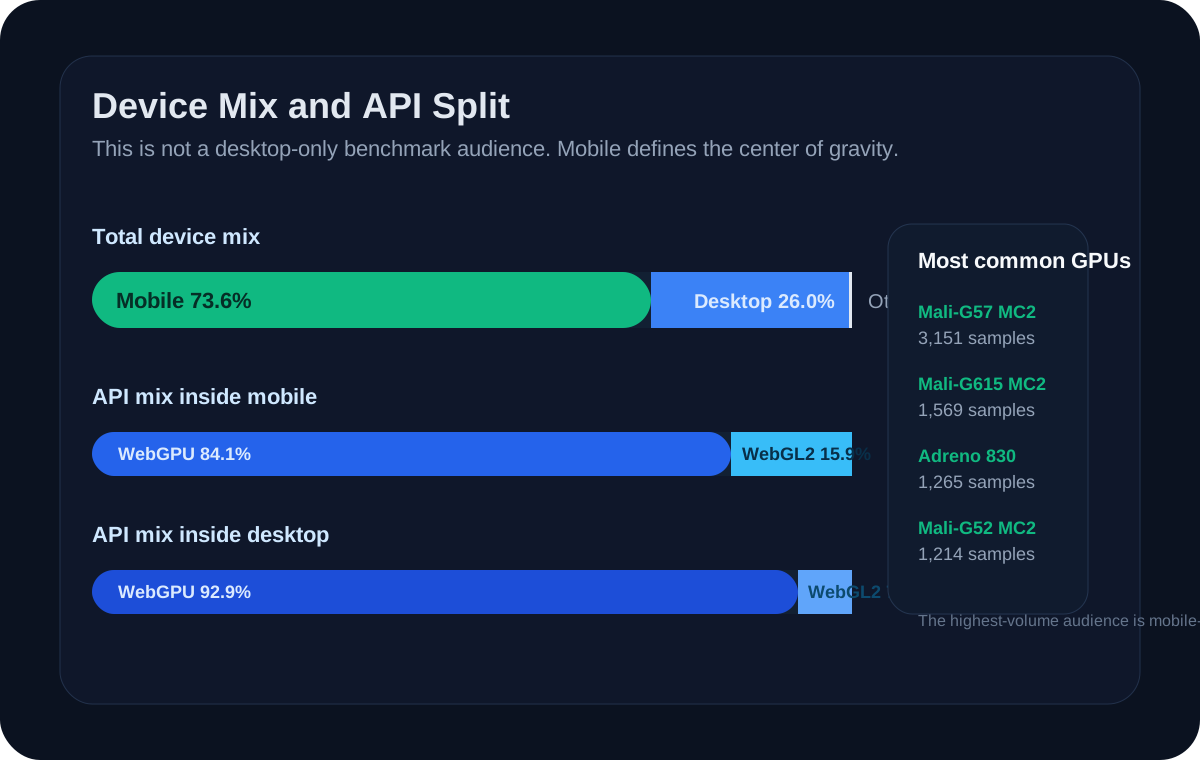
Out of 32,604 submissions
23,990
mobile devices
8,492
desktop devices
122
other bucket
That means mobile represented 73.6% of the full dataset. The benchmark’s center of gravity is not the RTX 4090. It is the mass-market phone GPU trying to survive a shader-heavy workload inside tighter thermal, power, and browser constraints.
High-volume GPU
Mali-G57 MC2
3,151 samples
High-volume GPU
Mali-G615 MC2
1,569 samples
High-volume GPU
Adreno 830
1,265 samples
High-volume GPU
Mali-G52 MC2
1,214 samples
Editorial read
This is a mass-market device profile, not a boutique enthusiast profile.
The real UX question is whether ordinary devices can sustain the workload at all, and under which presets.
| GPU | Median FPS | Interpretation |
|---|---|---|
| Mali-G615 MC6 | 81.0 | Comfortable for an interactive workload |
| Adreno 830 | 76.0 | Strong high-end mobile result |
| Mali-G57 MC2 | 34.0 | Playable, but clearly mid-tier |
| Mali-G52 MC2 | 18.3 | Borderline for a smooth experience |
| Adreno 610 | 4.7 | Not viable for this workload |
| PowerVR Rogue GE8320 | 5.4 | Also not viable |
Runtime split
WebGPU is the main road now, but the dataset still needs careful reading
The API split is no longer subtle. WebGPU is the default runtime path across both desktop and mobile in this audience.
API share
28,092 submissions used WebGPU.
4,512 submissions used WebGL2.
WebGPU accounted for 86.2% of all recorded runs.
By device type
Desktop: 92.9% WebGPU
Mobile: 84.1% WebGPU
WebGL2 remains important as a fallback, not as a replacement narrative.
Backend distribution
Vulkan: 19,020 samples
ANGLE-D3D11: 7,694 samples
ANGLE-OpenGL ES: 1,683 samples
ANGLE-Metal: 215 samples
Practical reading
At lighter presets, WebGPU wins clearly in aggregate.
At heavier presets, the gap narrows or reverses.
That does not prove WebGL2 is stronger. It proves mixed-population production data needs controlled interpretation.
| Preset | WebGPU avg FPS | WebGL2 avg FPS | Ratio |
|---|---|---|---|
| Ultra Low | 56.0 | 35.2 | 1.59x |
| Balanced | 35.7 | 23.3 | 1.53x |
| Reset | 32.1 | 27.7 | 1.16x |
| High | 23.4 | 24.4 | 0.96x |
| Very High | 19.7 | 20.8 | 0.95x |
| Extreme | 14.5 | 16.1 | 0.90x |
| Insane | 7.4 | 9.4 | 0.78x |
Preset strategy
Presets are doing real product work, not just organizing the chart
Preset-aware interpretation is what keeps this benchmark from collapsing into a flat pile of incomparable numbers.
Ultra Low
26,244
Balanced
1,471
High
1,232
Low
1,144
Very High
955
Relevant for preset
28,713
Ultra Low is the benchmark’s true front door.
If nearly the entire dataset funnels through one preset, that preset is not just a convenience option. It is the main onboarding surface. The fairness filter is reducing apples-to-oranges comparisons between entry-class mobile silicon and much stronger desktop GPUs on mismatched difficulty targets.
| Desktop GPU | Median FPS |
|---|---|
| NVIDIA GeForce RTX 5060 | 98.2 |
| NVIDIA GeForce RTX 4060 | 82.8 |
| NVIDIA GeForce RTX 4050 | 71.6 |
| NVIDIA GeForce RTX 3050 6GB | 55.6 |
| Intel Iris Xe Graphics | 11.5 |
Data quality
The dataset is valuable, but not clean enough for absolute claims
The fill rates are strong enough for product direction and content strategy, but several telemetry signals still need cleanup before the claims can get louder.
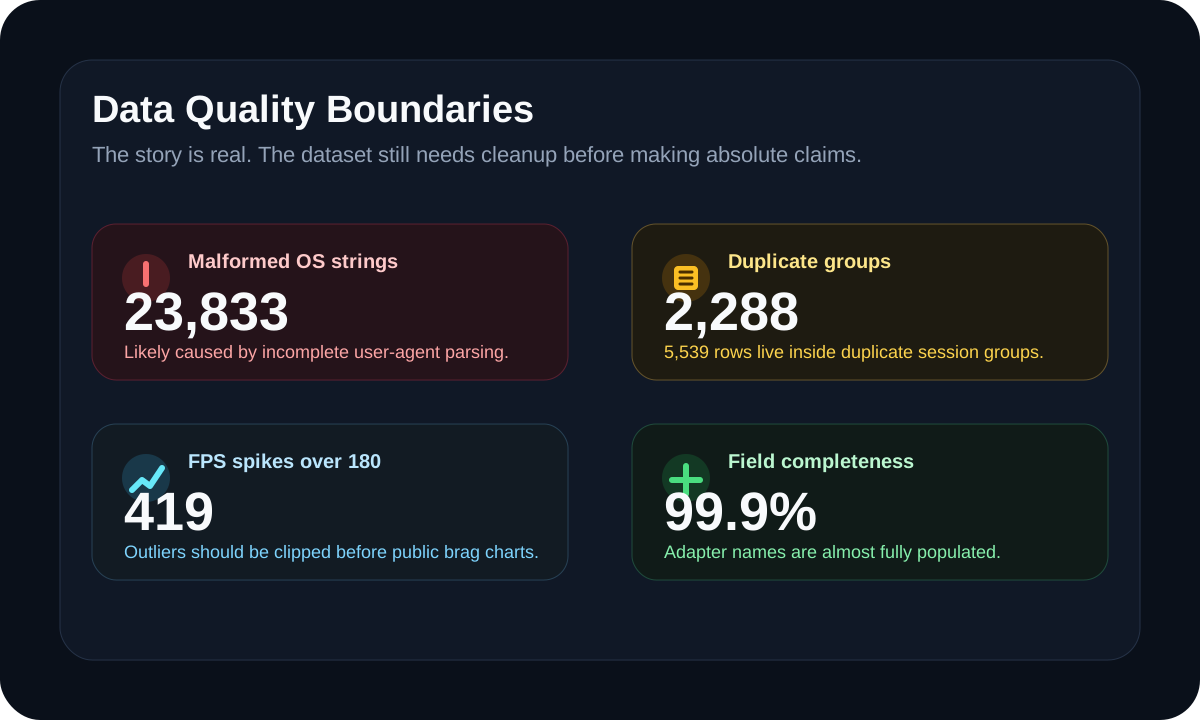
Malformed OS strings
23,833
Duplicate groups
2,288
Rows inside duplicate groups
5,539
FPS spikes above 180
419
The max-FPS story is weaker than the median-FPS story.
Adapter fill rate is 99.9%. Browser and OS fill rates are 100%. Backend fill rate is 88.3%. The trend lines are real, but the confidence bands are uneven, and the current stability metric is not ready to carry the narrative on its own.
Roadmap
What Volume Shader should do next
If this report is treated as a product input rather than just a content asset, the next actions become fairly obvious.
Treat mobile as the primary benchmark audience
Android Chrome and Vulkan-class backends should be the core path, not a secondary compatibility lane.
Keep WebGL2 healthy
WebGPU is the default path, but WebGL2 still matters for coverage, regression defense, and broader browser support.
Tighten public segmentation
Device class, preset, API, and tier should all shape how public results are presented.
Clean telemetry before louder claims
OS normalization, duplicate suppression, outlier clipping, and a better stability metric would strengthen every future report.
Publish more analysis, not just more scores
The current dataset already supports monthly snapshots, preset guides, mobile GPU spotlights, and browser comparison breakdowns.
FAQ
The short answers decision-makers usually need
This is the compact interpretation layer for teams reading the benchmark as product evidence.
What does this benchmark actually measure?
It measures real-time rendering throughput under a shader-heavy browser workload, using FPS, frame time, preset metadata, adapter strings, and environment context.
Is this report mainly about mobile or desktop?
In practice it is mainly about mobile. 73.6% of all submissions in the analysis window came from mobile devices.
Does this prove WebGPU always beats WebGL2?
No. It shows that WebGPU is the dominant runtime path in this production dataset, not that it universally wins under perfectly matched lab conditions.
What should teams do with this report?
Use it for product prioritization, preset strategy, telemetry cleanup, and editorial direction rather than as a simplistic universal winner chart.
Bottom line
Browser GPU benchmarking is now a mainstream web performance problem, shaped more by mobile volume, entry-tier hardware, preset design, and telemetry hygiene than by a narrow set of flagship desktop scores.